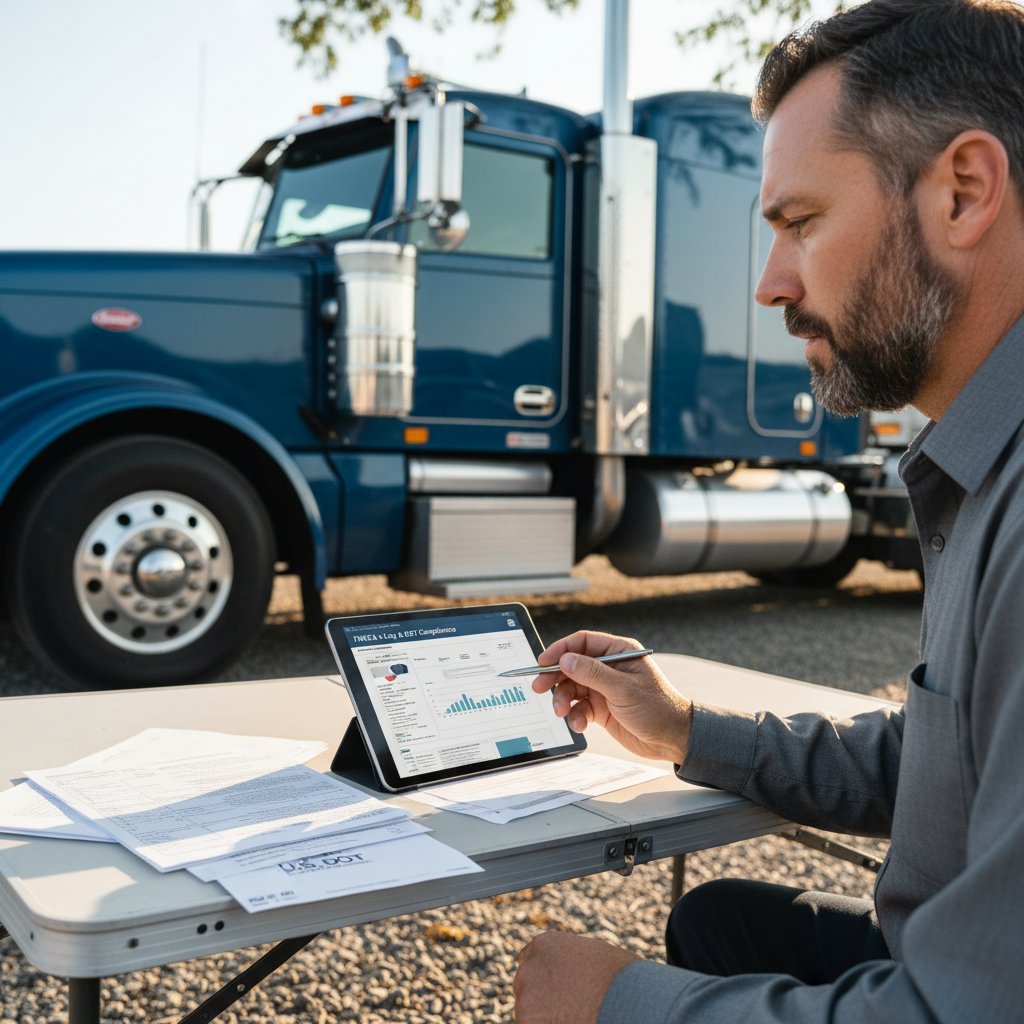
Don’t guess on trucking insurance. Learn insurance requirements for owner operators, FMCSA minimums, broker-ready limits, filings, and the coverage stack that keeps your authority active and your loads accepted.
Insurance requirements for owner operators come down to two things: the FMCSA’s legal minimums (often $750,000–$5,000,000 in public liability depending on cargo) and the higher limits brokers and shippers actually demand (often $1,000,000 liability plus $100,000–$250,000+ cargo). If you’re running under your own authority, you also need the right filings (like BMC-91/91X and BOC-3) on file or your authority may not activate.
This guide breaks down the coverages, costs, and filings owner-operators deal with in the real world, not just on paper. If you want a deeper breakdown of what each coverage does, see Logrock’s guide on owner-operator insurance coverage.
Key Takeaways: Essential Insurance Requirements for Owner Operators
- FMCSA minimums aren’t the market standard: You can be legal at $750,000, but many brokers won’t load you without $1,000,000 auto liability.
- Cargo + liability + physical damage are the “survival stack”: These are the core of real-world trucking insurance under your own authority.
- Filings matter as much as coverage: No filing can mean no active authority—know BMC-91/91X, MCS-90, and BOC-3.
- Leased-on vs. own authority changes everything: Your insurance requirements depend on who is primary under the lease and how you actually operate.
Table of Contents
Reading time: 11 minutes
- FMCSA Minimums vs Broker Requirements for Owner Operators (The Gap That Kills Loads)
- Insurance Requirements for Owner Operators: The Coverage Stack (What You Actually Need)
- Leased-On vs Own Authority: Insurance Requirements for Owner Operators
- Authority & Insurance Filings: Step-by-Step Timeline (BMC-91X, MCS-90, BOC-3)
- How Much Does Owner-Operator Trucking Insurance Cost in 2026?
- State + Intrastate Insurance Requirements: What to Watch
- How to Lower Your Premium Without Getting Burned
- What Happens If You Run Without Proper Insurance (Real Consequences)
- Frequently Asked Questions
- The Logrock Difference: Insurance Built for Owner-Operators
- Conclusion: Get a Quote That Won’t Get Rejected
FMCSA Minimums vs Broker Requirements for Owner Operators (The Gap That Kills Loads)
FMCSA financial responsibility rules set interstate public liability minimums that commonly start at $750,000 for general freight and can go up to $5,000,000 for certain hazardous materials under federal regulations (commonly referenced under 49 CFR Part 387).
The FMCSA sets the minimum, but brokers and shippers set the “real” standard you need to keep freight moving. If you shop semi truck insurance based only on “what’s legal,” you can end up compliant—but sitting.
Featured Snippet: FMCSA public liability minimums (by cargo)
| Cargo / Operation Type | FMCSA Minimum Public Liability (Interstate) |
|---|---|
| General freight (non-hazmat) | $750,000 |
| Oil / petroleum | $1,000,000 |
| Certain hazardous materials | $5,000,000 |
What this means in plain English: the minimum depends on what you haul, but many brokers require $1,000,000 even if you haul general freight—and specialized freight can require more.
The “legal” minimum vs. the “get-me-loaded” minimum
| Item | FMCSA Minimum | Common Broker/Shipper Reality |
|---|---|---|
| Auto Liability | $750,000 (general freight) | $1,000,000 is common |
| Cargo | Not always federally mandated | $100,000–$250,000+ common on broker packets |
| General Liability | Not an FMCSA requirement | Often required for certain facilities/contracts |
Pro tip (business owner mindset): If you pull from major load boards and want broker setup to move fast, price your insurance as if $1,000,000 liability + meaningful cargo is required—because most weeks, it is.
Insurance Requirements for Owner Operators: The Coverage Stack (What You Actually Need)
Most owner-operators running under their own authority need a core “stack” of auto liability, motor truck cargo, and physical damage, with add-ons like non-trucking liability and general liability depending on contracts and dispatch status.
This is the mix that tends to keep you compliant, protect cash flow, and prevent those painful “not covered” moments after an accident or cargo claim.
1) Primary Auto Liability (Required to Run Under Your Own Authority)
- What it is: Pays for injuries and property damage you cause while operating your truck.
- Why it matters: One at-fault crash can trigger lawsuit exposure that dwarfs a truck payment, and liability is the backbone coverage behind FMCSA financial responsibility.
- Who needs it: Any owner-operator running under their own motor carrier authority (interstate).
- Veteran advice: The $750,000 minimum may be legal for general freight, but $1,000,000 is often the price of entry with brokers.
2) Motor Truck Cargo Insurance (Because Brokers Don’t Pay for Your Mistake)
- What it is: Covers damage or loss to freight you’re legally liable for while hauling.
- Why it matters: A cargo claim can wipe out a month of profit fast, and many brokers won’t set you up without cargo on file.
- Who needs it: Most owner-operators hauling brokered freight; common for hotshot setups too, especially on higher-value loads.
- Veteran advice: Match cargo limits to the worst day you haul, not the average day—especially on reefer, electronics, or high-theft commodities.
3) Physical Damage (Collision + Comprehensive) (Protects Your Truck as an Asset)
- What it is: Pays to repair/replace your truck for collision, theft, vandalism, weather, or animal hits.
- Why it matters: Lenders usually require it on financed equipment, and it protects your balance sheet even if the truck is paid off.
- Who needs it: Anyone who can’t replace their rig with a check tomorrow.
- Veteran advice: Raise deductibles only if your emergency fund can actually absorb the hit without derailing operations.
4) Non-Trucking Liability (NTL) / Bobtail (Avoid the Off-Duty Coverage Gap)
- What it is: Liability coverage for when you’re not under dispatch (exact trigger depends on policy wording).
- Why it matters: A common trap is assuming you’re covered while deadheading home, grabbing food, or moving for parking when you’re not “on the load.”
- Who needs it: Many leased-on owner-operators and some authority holders, depending on how primary liability is structured.
- Veteran advice: Don’t guess—dispatch status and trailer attachment rules vary by insurer and contract language.
5) General Liability (GL) (Slip-and-Fall and “Non-Auto” Claims)
- What it is: Covers third-party injury/property damage not caused by driving (dock damage with equipment, slip-and-fall, etc.).
- Why it matters: Some facilities and contracts require it, and it reduces out-of-pocket surprises.
- Who needs it: Owner-operators doing direct shipper work or taking on contract requirements beyond standard brokered freight.
6) Trailer Interchange (If You’re Hooking to Non-Owned Trailers)
- What it is: Covers physical damage to a trailer you don’t own but are responsible for under a written interchange agreement.
- Why it matters: If you sign interchange language, you can be financially responsible for that trailer while it’s in your care.
- Who needs it: Operators in drop-and-hook or interchange arrangements with written agreements.
7) Occupational Accident / Workers’ Comp Alternatives (Protects You, the Human Asset)
- What it is: Medical and disability benefits for the driver (often used by owner-operators instead of workers’ comp, depending on state and setup).
- Why it matters: If you’re the business, an injury can shut down revenue instantly.
- Who needs it: Many owner-operators, especially leased-on, depending on lease requirements and state rules.
- Veteran advice: Read benefit limits, waiting periods, and exclusions—cheap coverage that doesn’t pay when you’re sidelined isn’t savings.
Leased-On vs Own Authority: Insurance Requirements for Owner Operators
Insurance requirements for owner operators change based on who holds the operating authority, because the motor carrier with authority is typically the party responsible for primary liability and the FMCSA compliance filings tied to that authority.
This is where a lot of people get burned—because “I have insurance” isn’t specific enough. The question is whose policy is primary, when it applies, and what the lease shifts back onto you.
Quick comparison: leased-on vs. running under your own authority
| Category | Leased On to a Motor Carrier | Own Authority (You’re the Motor Carrier) |
|---|---|---|
| Who usually carries primary liability? | The motor carrier (check the lease) | You |
| Common insurance you still need | Physical damage, NTL/bobtail, occ/acc | Liability, cargo, physical damage, GL (often) |
| Who handles FMCSA filings? | Carrier typically does | You/your agent must file |
| Business reality | Less admin, less control | More control, more paperwork, more responsibility |
Lease pitfalls that impact insurance (read before you sign)
- “Primary liability provided” doesn’t mean “you’re fully protected.” Deductibles, exclusions, and non-dispatched time are where surprises live.
- Cargo responsibility can be shifted. Some leases push cargo liability back onto you in specific scenarios.
- Deadhead and bobtail rules vary. Clarify whose policy applies, when it applies, and what counts as “under dispatch.”
Pro tip: If a carrier says “we cover you,” ask for the limits, deductibles, when coverage applies (under dispatch vs off), and whether they require you to carry non-trucking liability.
Authority & Insurance Filings: Step-by-Step Timeline (BMC-91X, MCS-90, BOC-3)
FMCSA authority activation typically requires proof of liability on file (via filings like BMC-91/BMC-91X) plus a process agent filing (BOC-3), and many liability policies include the MCS-90 endorsement for federal financial responsibility compliance.
Buying commercial truck insurance is only half the job—filings are what the FMCSA (and sometimes your state) uses to confirm you’re compliant.
Step 1: Buy the correct policy for your operation (don’t bind the wrong type)
Before filings happen, the policy must match the reality of how you run:
- Power unit type: tractor, straight truck, hotshot pickup
- Radius and states: local, regional, long-haul
- Commodity: general freight vs hazmat vs auto hauler vs reefer
- Drivers: owner details, MVR, verifiable experience
If you’re running hotshot, underwriting can change fast based on GVWR, cargo type, and radius—so “close enough” information can lead to wrong pricing or claim issues later.
Step 2: File proof of financial responsibility (BMC-91 or BMC-91X)
- What it does: Shows the FMCSA you have the required liability coverage for your authority.
- BMC-91 vs BMC-91X: The format varies, but the point is the same—proof must be on file and current.
Step 3: Make sure the MCS-90 is attached (federal endorsement)
- What it does: It’s an endorsement tied to federal financial responsibility rules.
- Why you care: It affects how certain liability obligations work under federal rules; it’s not “bonus coverage,” but it matters in enforcement and claims handling.
Step 4: File BOC-3 (process agent)
- What it does: Lists your legal representatives for service of process in each state.
- Why it matters: Without it, your authority won’t activate.
Step 5: Confirm your authority is active before you roll
Don’t assume—verify your status before you start running loads. An “inactive” status can mean cancelled loads, payment delays, and serious enforcement problems if you get inspected.
Practical timeline mindset: If you’re trying to go from “LLC filed” to “hauling tomorrow,” you’re likely to miss something. Plan for setup time and mistakes.
How Much Does Owner-Operator Trucking Insurance Cost in 2026?
Owner-operator trucking insurance commonly ranges from $700 to $2,500+ per month for many general freight operations, while hazmat and other high-risk commodities can run $2,500 to $6,000+ per month depending on limits, losses, and lanes.
Cost varies widely, but these ranges are realistic for budgeting without fantasy numbers.
Typical monthly premium ranges (ballpark)
| Profile | Typical Monthly Range (2026) | What drives it |
|---|---|---|
| New authority, 1 truck, general freight | $900–$2,500+ | New venture risk, lanes, experience, loss history |
| Established authority, clean losses | $700–$1,800 | Tenure, safety, stable operations |
| Hotshot (varies by GVWR, cargo, radius) | $500–$1,800 | Cargo type, states, equipment, claims |
| Hazmat / high-risk commodities | $2,500–$6,000+ | Higher required limits + claim severity |
Reality check: If a quote is drastically under market, it’s often because something is off—wrong classification, missing coverage, limits brokers won’t accept, or exclusions that will hurt when you need the policy.
What actually moves the price (the underwriter’s view)
- Authority age: new authority vs seasoned authority
- Driving record: MVR + verifiable experience
- Commodity: theft exposure and severity
- Operating radius and lanes: congestion and claims frequency
- Equipment value + deductibles: physical damage pricing
- Loss runs: prior claims history
- Credit/payment plan: where allowed by state rules
Business owner tip: The lowest premium isn’t the lowest cost. The goal is the lowest cost per mile of risk without getting your COI rejected.
State + Intrastate Insurance Requirements: What to Watch
Intrastate trucking is regulated at the state level, and some states set liability minimums or require filings that differ from the FMCSA’s interstate baseline, especially for specialized operations like household goods or passenger carriers.
FMCSA rules apply to interstate commerce, but if you operate only within one state (or think you do), your state DOT/PUC requirements may control—and they can be different.
Common state-level “gotchas” for owner-operators
- Higher intrastate liability minimums than the federal baseline (varies by state)
- State-specific filings separate from FMCSA
- Different rules for household goods, passengers, or specialized operations
- Different proof formats than a standard COI
How to protect yourself without memorizing 50 rulebooks
- List every state you run (including “sometimes” lanes).
- Confirm whether you’re truly intrastate or occasionally cross state lines.
- Match your policy radius, commodity, and filings to reality.
- Keep COIs and filing confirmations organized so broker onboarding doesn’t stall.
Bottom line: Don’t let a technicality shut you down at the scale. If your ELD and bills show you crossed state lines, you want your authority and filings aligned with that reality.
What Happens If You Run Without Proper Insurance (Real Consequences)
Operating without the correct coverage and active filings can lead to inactive authority, broker packet rejection, and claim denials that leave you personally paying for losses that your policy doesn’t respond to.
This isn’t scare tactics—this is how owner-operators lose weeks (or their authority) over preventable issues.
1) Authority can be shut down (inactive = not getting paid)
If filings cancel or don’t match requirements, you can end up with inactive authority, which often leads to:
- Brokers refusing to load you
- Dispatch turning into chaos
- Cash flow stopping
2) Claims get denied (the “wrong coverage” problem)
Common denial triggers include:
- Wrong business use (personal vs business)
- Commodity misclassification
- Operating outside declared radius/states
- Off-dispatch accidents without the right NTL/bobtail structure
3) Broker packet rejection (quiet failure)
Sometimes you don’t get a clean “no.” You just stop getting emails back because your COI doesn’t meet requirements like:
- $1,000,000 liability
- Required cargo limits
- Additional insured wording
- Waiver of subrogation wording
Business takeaway: Proper coverage is a revenue enabler, not just an expense line.
Frequently Asked Questions
Most owner-operator insurance questions come down to FMCSA-required liability limits, broker-required cargo limits, and whether your filings and dispatch status match what your policy actually covers.
Most owner-operators need primary auto liability (often $1,000,000 to satisfy broker packets), plus motor truck cargo (commonly $100,000–$250,000+) and physical damage if the truck is financed or you can’t self-insure the rig. If you run under your own authority, you also need your FMCSA compliance items in place, including liability filed via BMC-91/BMC-91X and a BOC-3 process agent filing to activate authority. If you’re leased-on, the carrier may provide primary liability, but you may still need physical damage, non-trucking liability, and occupational accident depending on the lease and dispatch rules.
Owner-operator insurance commonly costs $700 to $2,500+ per month for many general freight operations, with new authorities often landing toward the higher end due to “new venture” underwriting. Hotshot setups can range roughly $500 to $1,800 depending on GVWR, cargo, and radius, while hazmat or higher-risk commodities can run $2,500 to $6,000+. Pricing is driven by authority age, verifiable experience, MVR, loss history, lanes, cargo theft exposure, equipment value, deductibles, and limits. If the price looks unrealistically low, it’s often because the classification, limits, or coverage terms won’t hold up to broker requirements or a real claim.
Yes, owner-operators often need cargo insurance because brokers and shippers commonly require it even when it isn’t federally mandated for every operation. In practice, many broker packets expect cargo limits like $100,000, and higher-value freight can require $250,000+ (or more) depending on the commodity. Cargo coverage protects you from freight claims that can erase months of profit in one incident, especially on reefer, electronics, or high-theft lanes. The smart move is to match the limit and coverage terms to the highest-value load you realistically haul, and confirm key exclusions (like unattended vehicle, temperature controls, or theft conditions) before you rely on the policy.
Non-trucking liability (NTL) generally covers liability when you’re not under dispatch, while “bobtail” commonly refers to driving without a trailer, and those are not always the same thing under insurance wording. Many claims problems happen when a driver assumes bobtail automatically means off-duty coverage, but the policy only triggers based on dispatch status (and sometimes business vs personal use). NTL may not apply if you’re still considered under dispatch, repositioning for the next load, or performing business use that the policy excludes. The correct answer depends on the exact policy language and your lease agreement, so it’s worth confirming in writing before you depend on it.
Leased-on owner-operators typically operate under the motor carrier’s authority, and the carrier often provides primary auto liability, while owner-operators with their own authority must carry their own liability and keep FMCSA compliance filings active. With your own authority, you’re usually responsible for broker-ready limits (often $1,000,000 liability and significant cargo), COIs, and filings like BMC-91/BMC-91X and BOC-3. Leased-on setups can reduce admin, but you still may need physical damage, NTL/bobtail, and occupational accident depending on the lease and dispatch rules. Either way, the lease language and policy triggers determine what’s actually covered.
The Logrock Difference: Insurance Built for Owner-Operators
Logrock focuses on building owner-operator trucking insurance that meets FMCSA compliance needs while also matching broker packet requirements like $1,000,000 liability and realistic cargo limits.
Owner-operators don’t need generic templates—they need coverage that matches how they run: lanes that change week to week, parking realities, broker requirements, and the fact that one claim or paperwork miss can choke cash flow.
- Coverage stack built around your operation: authority status, trailer setup, commodity, and radius.
- Filings and COIs handled correctly: so you can stay loaded instead of stuck in onboarding.
- Gap prevention: we look for the “quiet” issues that only show up after a wreck or a cargo claim.
Conclusion: Get a Quote That Won’t Get Rejected
The right insurance requirements for owner operators come down to meeting legal minimums, meeting broker reality, and making sure your filings and operations match your policy.
If you want a quote built around how you actually run—lanes, cargo, trailer setup, and authority status—do it now while you’re not in the middle of a breakdown or a claim.
Key Takeaways:
- FMCSA minimums are the floor: many brokers expect $1,000,000 liability for general freight.
- Build the survival stack: liability + cargo + physical damage, then close gaps (NTL/bobtail, GL, occ/acc) based on your contracts and dispatch rules.
- Filings activate authority: coverage without the correct filings can still leave you parked.
Related Reading: Owner Operator Insurance Coverage (2026), Get a Quote, and Logrock.